Mechanical Stress in Ice-Melting Experiments for Iceberg Research
Posted by

 Precise Simulation
–
Precise Simulation
–
Precise Simulation
–

Melting of the submerged part of an iceberg, its keel, releases freshwater below the ocean surface, influencing water circulation, mixing, and local seawater conditions. Understanding how quickly the keel melts requires relating ice loss to seawater temperature and salinity. In her 2026 University of Manitoba master’s thesis, A Thermodynamic Rate of Ablation for Iceberg Keels, E. A. Marie combined laboratory experiments and published measurements to develop a model of ice ablation (loss of ice at the surface) as a function of these variables. She then applied it to a model iceberg using estimates of glacier density and trapped-air pressure, together with ocean conditions from a reanalysis product.
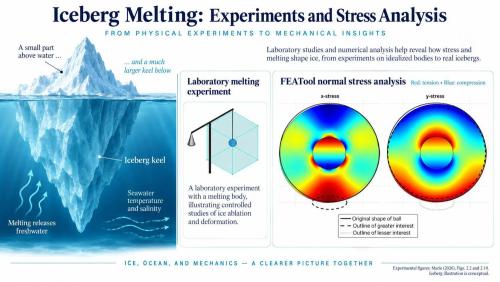
Within that broader work, finite element stress analysis of ice helped examine whether the experimental arrangement itself could influence measured melting. Marie used FEATool Multiphysics in MATLAB to perform finite element analysis (FEA) of a lead-core ice ball, comparing the calculated stress patterns with published melt shapes. The results supported her interpretation that mechanical loading could affect the observed pattern, helping assess the suitability of experiments used to investigate thermodynamic ablation.
Visit https://featool.com/model-showcase/2026-09-17-Ice-Ball-Stress-Ablation/ for more information and to download FEATool Multiphysics.
Within that broader work, finite element stress analysis of ice helped examine whether the experimental arrangement itself could influence measured melting. Marie used FEATool Multiphysics in MATLAB to perform finite element analysis (FEA) of a lead-core ice ball, comparing the calculated stress patterns with published melt shapes. The results supported her interpretation that mechanical loading could affect the observed pattern, helping assess the suitability of experiments used to investigate thermodynamic ablation.
Visit https://featool.com/model-showcase/2026-09-17-Ice-Ball-Stress-Ablation/ for more information and to download FEATool Multiphysics.

| Free forum by Nabble | Edit this page |