Convergence and pressure issues with HT-NS-Br coupling at fluid-porous interface

Next Topic
 
classic Classic list List threaded Threaded
4 messages Options
Reply | Threaded
Open this post in threaded view
|

Convergence and pressure issues with HT-NS-Br coupling at fluid-porous interface

Sergio
Dear FEATool Support Team,

I am writing to request assistance with a Conjugate Heat Transfer (HT), Navier-Stokes (NS), and Brinkman (Br) coupled model that is experiencing solver divergence.

Model Geometry and Domains:

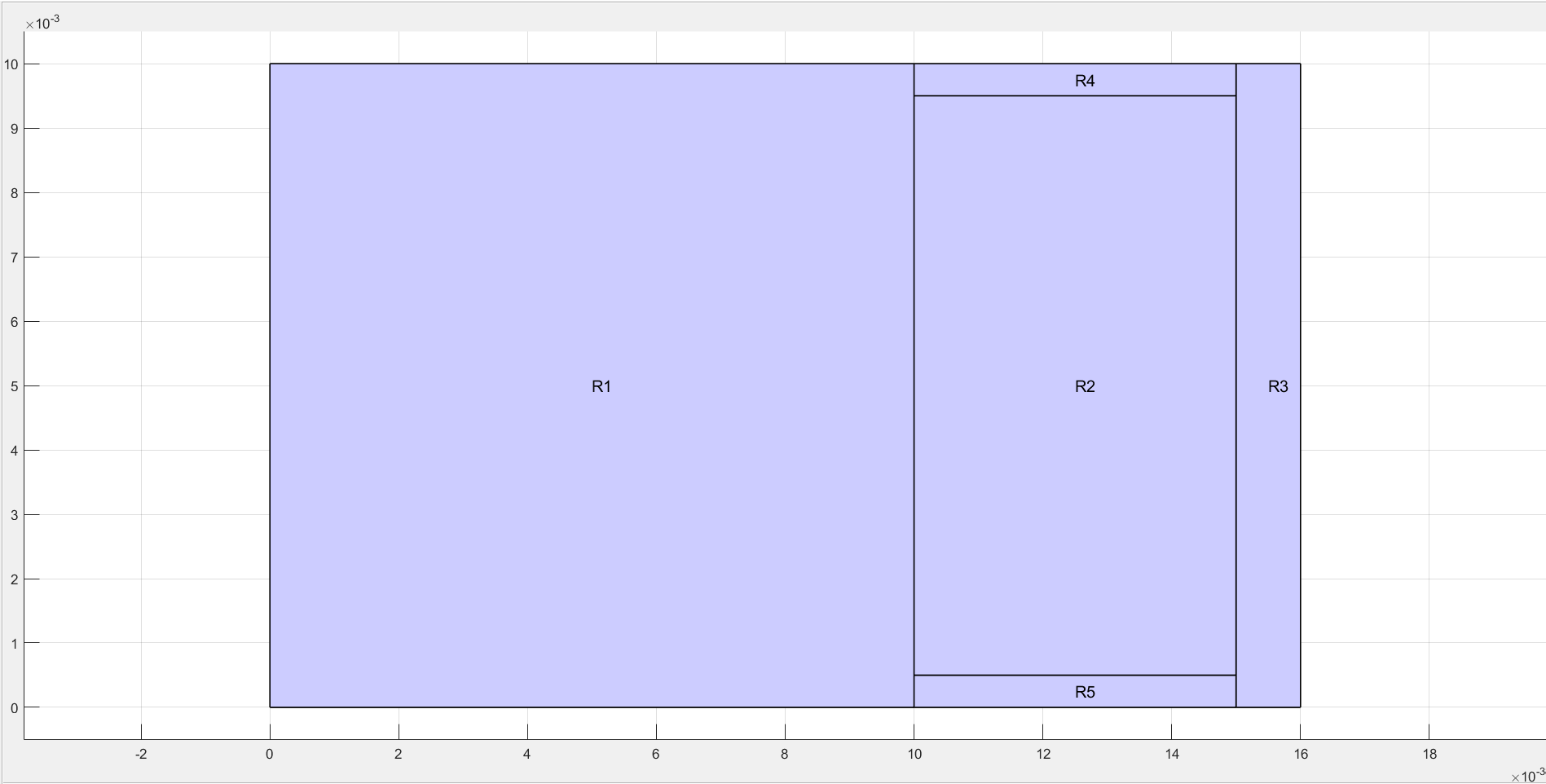
My model consists of five domains labeled R1 through R5:
- Solids: R1 and R3
- Fluid: R2
- Porous Media: R4 and R5

Boundary Conditions and Flow Path:
-Inlet: Located at the R1-R2 interface, where fluid enters the fluid domain (R2).
- Internal Interfaces: Fluid-porous interfaces occur at the R2–R4 and R2–R5 boundaries.
- Interface BCs: Fluid-porous continuity is set to v_ns=v_br and P_ns = P_br.
- Outlets: Located at the outer boundaries of R4 and R5, with a fixed pressure of 1200 Pa.

Issue Description:
HT-NS-Br Coupling Case: When running the full HT-NS-Br physics, the solver "blows up" and fails to converge. The issue appears localized at the fluid-porous interfaces (R2-R4 and R2-R5). When I try different BC the solver converges but the results for the pressure are way off what I expect.

HT-Br Simplified Case: If I isolate the physics to just HT-Br, the model converges successfully. However, the resulting pressure distribution does not match established literature data.

Could you please provide guidance on the correct interface boundary condition setup or solver settings needed to stabilize this specific Brinkman-Navier-Stokes coupling in FEATool?

Please see attached files.
HT-BR_Test.feaHT-NS-BR-Test.fea
Thank you for your time and assistance.
Reply | Threaded
Open this post in threaded view
|

Re: Convergence and pressure issues with HT-NS-Br coupling at fluid-porous interface

Precise Simulation
Administrator
Sergio wrote
When I try different BC the solver converges but the results for the pressure are way off what I expect.

The resulting pressure distribution does not match established literature data.
Hi Sergio, could you also provide the "pressure that you expect", and the "established literature data" that you are trying to match.
Reply | Threaded
Open this post in threaded view
|

Re: Convergence and pressure issues with HT-NS-Br coupling at fluid-porous interface

Sergio
In reply to this post by Sergio
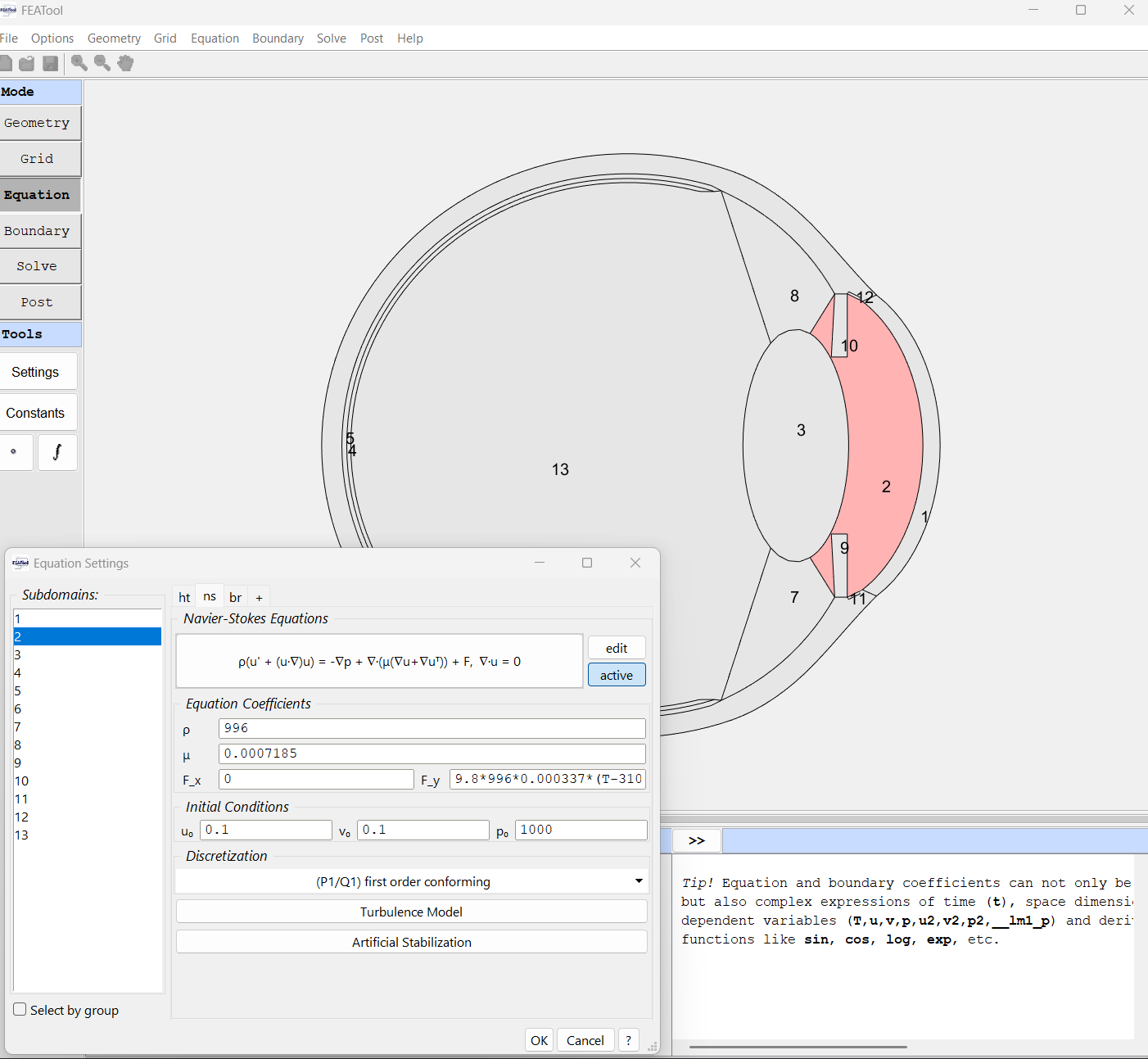
The actual FEA sim that I'm trying to solve is that of a 2D heat transfer of the human eye. I've used Comsol 6.3 and was able to get matching results with literature data. I'm trying to replicate those results with FEATool. I've tried different BC at the fluid-porous interface but none come close to the expected results.

You can find the technical document and my FEATool model in the google drive link below. The FEA file is too big to attach it here. The expected pressure in domain #2 is in the range of 1500-2000 Pa when the outlet pressure at domain 12 and 11 is set to 1200 Pa. The BC at the domain interface #2-11 and #2-12 are: vns = vbr and Pns = Pbr.

Any suggestions are appreciated. Thank you.

 https://drive.google.com/drive/folders/1i-C6r9-v0SZ6DPj1XYgcB6JDZ-oQq-W7?usp=drive_link


https://drive.google.com/drive/folders/1i-C6r9-v0SZ6DPj1XYgcB6JDZ-oQq-W7?usp=drive_link

Reply | Threaded
Open this post in threaded view
|

Re: Convergence and pressure issues with HT-NS-Br coupling at fluid-porous interface

Precise Simulation
Administrator
In reply to this post by Sergio
So far I have had a look at your "HT-BR_Test.feaHT-NS-BR-Test.fea" model file and found a number of potential issues:

- "Subdomain Integral Constraints" for Brinkman Equations in Subdomains 2 and 4. These types of constraints are automatically added when no outflows are present (such as for the driven cavity model). Otherwise the pressure is unconstrained, and the solver will have difficulty to converge. Maybe they were added when you were experimenting. Remove them by nulling the corresponding fields (selecting "Subdomain Integral Constraint" menu option or mode Tools button in FEATool Multiphysics equation mode).

- I can't really explain how the gradient on Brinkman outflow boundaries 4 and 5 have internally been set to 1200 (as it is not possible to set anything but pressure on outflow boundaries). To fix this run the toolbox in MATLAB, "Export the Model Data Struct" to the MATLAB command line (from the "File" menu) and set:
    fea.phys.br.bdr.coef{4,end}{1,4} = 0;
    fea.phys.br.bdr.coef{4,end}{1,5} = 0;
  then re-import it into the FEATool GUI.

- The Navier-Stokes flow is very laminar Re approx 0.25, so unless you are sure you really need to use the full Navier-Stokes equations you can use the Brinkman equations in all fluid domains (and put a large number for kappa ~1e12 to effectively null this term in non-porous domains).

- Using a parabolic inlet velocity profile might also help a little as connecting non-zero flow velocities to zero (wall) boundaries is unphysical.

- Please check your "F_y" fluid source terms as they have very different magnitues in the porous and non-porous domains.

I have attached a modified file with the changes highlighted above (except for F_y): HT-NS-BR-Test_2.fea