Aortic Valve Finite Element Analysis
Posted by

 Precise Simulation
–
Precise Simulation
–
Precise Simulation
–

Finite Element Analysis (FEA) can reveal how aortic valve geometry affects leaflet stress, strain, and deformation throughout the cardiac cycle. In this study, patient-specific 3D models of tricuspid, bicuspid Type 0, bicuspid Type 1, and quadricuspid aortic valves were reconstructed from transesophageal echocardiography data and analyzed using FEATool Multiphysics under time-dependent pressure loading.
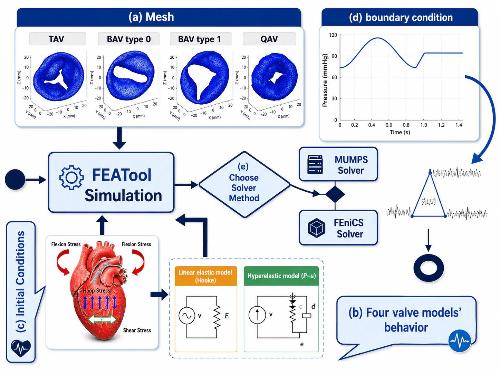
The simulations showed clear differences between healthy and congenital valve configurations, with bicuspid and quadricuspid geometries producing more localized stress concentrations and deformation than the tricuspid model. The work demonstrates how FEATool Multiphysics can be applied to patient-specific biomechanical FEA, including complex anatomical geometry, stress and strain evaluation, mesh sensitivity studies, and linear and nonlinear structural analysis.
Visit https://featool.com/model-showcase/2026-09-03-Aortic-Valve/ for more information and toolbox download.
The simulations showed clear differences between healthy and congenital valve configurations, with bicuspid and quadricuspid geometries producing more localized stress concentrations and deformation than the tricuspid model. The work demonstrates how FEATool Multiphysics can be applied to patient-specific biomechanical FEA, including complex anatomical geometry, stress and strain evaluation, mesh sensitivity studies, and linear and nonlinear structural analysis.
Visit https://featool.com/model-showcase/2026-09-03-Aortic-Valve/ for more information and toolbox download.

| Free forum by Nabble | Edit this page |